Before you read
Discuss these questions with your partner.
In chemistry and physics, what is an atom?
What is smaller than an atom?
What happens if you split an atom?
THE ATOM
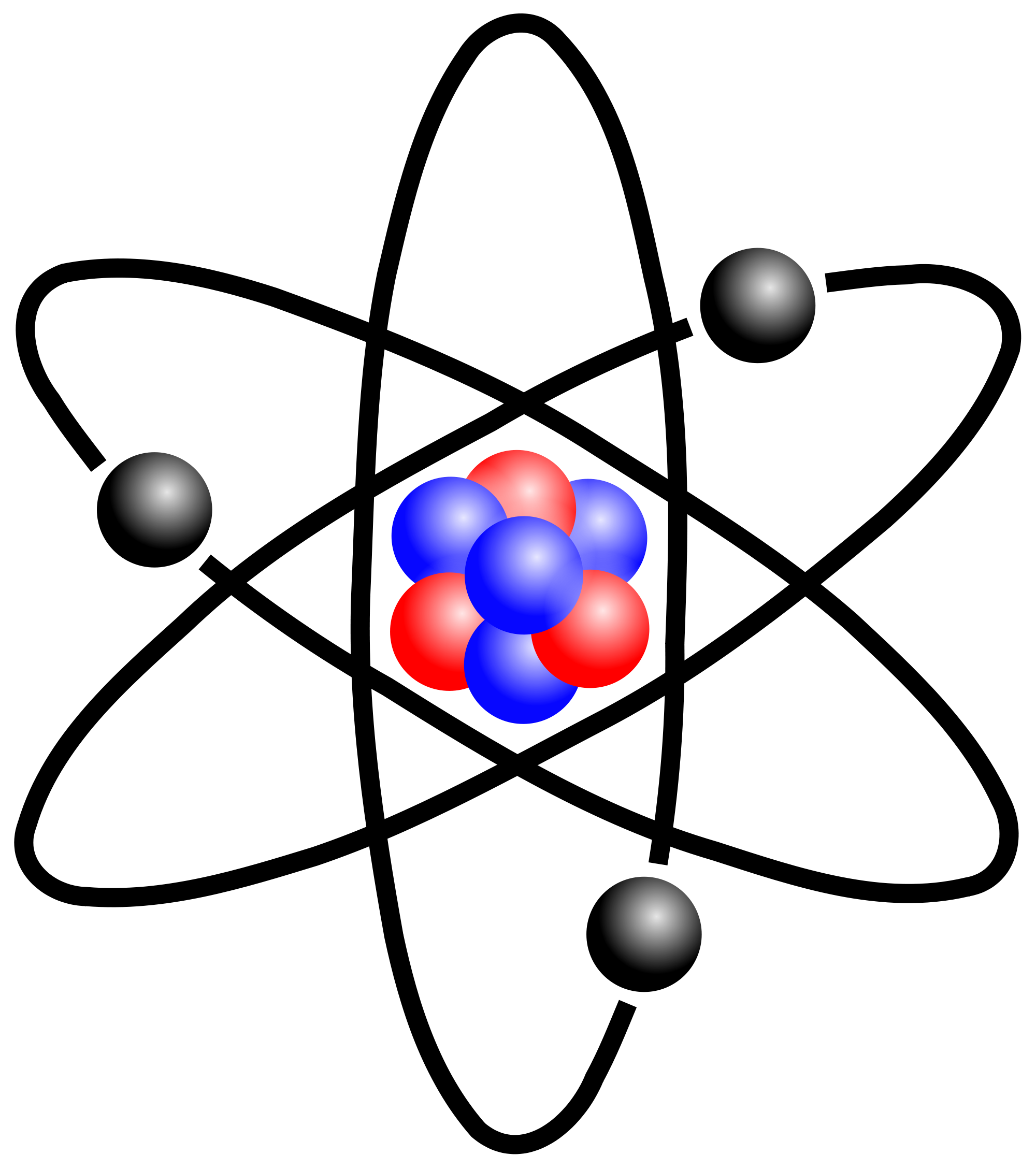
The ancient Greeks coined the term atomos, meaning the smallest possible separation of matter. In ancient times, both the Greeks and Indians had philosophised about the existence of the atom but, as mentioned in unit 6, it was first hypothesised scientifically by the British chemist John Dalton (1766-1844) in the early years of the 19th century, when he suggested it was the smallest particle that could exist. Since then, smaller subatomic particles have been discovered and the part they play as the basic building blocks of the universe is clear. We now know that atoms are made up of differing numbers of electrons, neutrons and protons, and these too are made up of even smaller particles.

Dalton's theory about atoms was not immediately accepted by chemists, though one reason for this was Dalton's well-known carelessness in experimental procedures. However, we know now that Dalton was correct in almost everything he said in his theory of the atom. He described an atom, even though he had never seen one, as a particle that cannot change its nature. It could, he observed, combine with the atoms of other chemical elements to create a compound. Almost a century later the first subatomic particles were discovered. By the 1930s, physicists were working 35 Macmillan Guide to Science Unit 10 with new ideas which allowed them to investigate the parts of the atom in great detail. In turn, these developments helped them to develop quantum mechanics - the basis of both modern chemistry and physics.
In chemistry, the atom is the smallest part of an element that can still be recognised. An example will explain best of all. Each element is identified by the number of protons it has. An atom of carbon has six protons. Those six protons without the neutrons and electrons, or the electrons without the other subatomic particles are simply subatomic particles; they are not carbon. A carbon atom can be combined with two atoms of oxygen to give the compound carbon dioxide, or C02. It is this difference in the number of subatomic particles that makes one atom different from another.
Subatomic particles also have another purpose. If there is the same number of electrons and protons in the atom, then the atom will be electronically neutral. A difference between the two means the atom has an electrical charge, in other words, it produces electricity. This electricity means the electrons can become attracted to each other. In this way, atoms can bond together to form molecules, and when enough molecules are joined together we have matter that we can see.
The most recent theories of the origins of the universe say that all the atoms in the universe were formed in the first few minutes of the universe coming into existence. The most common element is the simplest, hydrogen, which has the atomic number 1. Seventy-five per cent of all atoms are hydrogen atoms. The next most simple is the next most common, helium, atomic number 2 making twenty-four per cent of all atoms. All the other atoms add up to just one per cent of everything that exists in the universe.
Read the text and choose the
correct answer.
1 Dalton believed the atom to be
A an element.
В made of smaller particles.
С the smallest possible particle.
D his own idea.
2 Dalton's theories were
A generally accepted.
В not tested very carefully.
С accepted at once.
D not correct.
3 The number of protons in an element
A is the same as the number of electrons.
В is always six.
С never changes.
D characterises the element.
4 Electrons help
A protons to form elements.
В atoms to be neutral.
С molecules to become atoms.
D atoms to form molecules.
5 Hydrogen is
A the simplest atom there is.
В present in all atoms.
С the oldest atom.
D as common as helium.